09 Jun 2026
Beyond Antibiotics Faculty and Researchers present at Ox Tech Week: Biomedical Engineering

Prof Coussios presenting at the 2026 Ox Tech Week: Biomedical Engineering
Ox Tech Week (Oxford Tech Week) is Oxford’s flagship technology and innovation festival. Designed to connect academic research with venture capital and entrepreneurship, the four-day event brings together founders, scientists, investors, and policymakers. Through lectures and demonstrations, the Beyond Antibiotics research team showcased advances in drug delivery, organ preservation, and translational bioengineering. Collectively, the team highlighted the multidisciplinary nature of biomedical engineering, the importance of proximity to clinical environments, and the transformative potential of engineering-led solutions to address major healthcare challenges.
Introduction to Biomedical Engineering
Speaker: Professor Robin Cleveland PhD, Director of Institute of Biomedical Engineering, Professor of Engineering Science and Fellow of Magdalen College
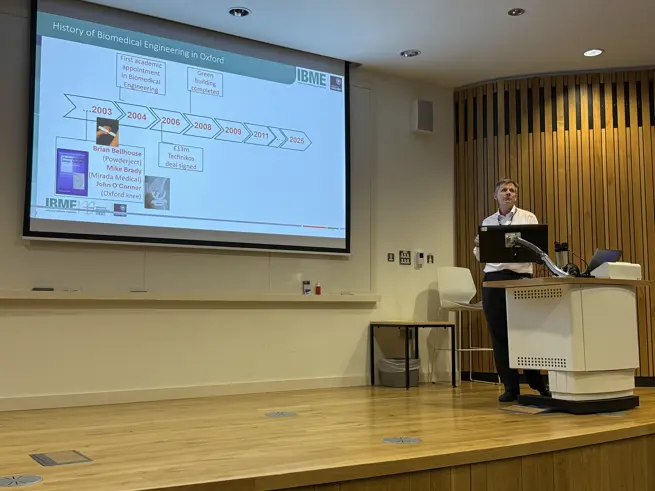
Professor Robin Cleveland provided a comprehensive introduction to Biomedical Engineering research in Oxford, outlining its scope across medical devices, diagnostics, and therapeutic technologies and both academic and translational success.
A key theme was the importance of close integration of research and clinical settings. Prof Cleveland emphasised that successful innovation depends not only on technical advances but also on strong links between research environments and healthcare systems.
Busting Bugs with Bubbles – Engineering Drug Delivery Systems Against Antibiotic Resistant Bacteria
Speaker: Professor Eleanor Stride OBE FREng HonFIET PhD BEng, Statutory Professor of Biomaterials and Fellow of St. Catherine’s College
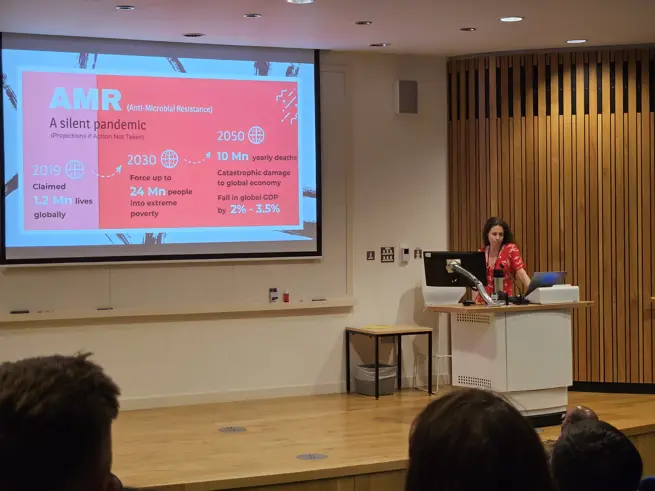
Professor Eleanor Stride showcased her research using engineering principles to address key challenges in antimicrobial resistance (AMR), which is conducted as part of the EPSRC-funded Beyond Antibiotics Programme Grant (Programme Grant Scheme reference number EP/V026623/1).
Prof Stride’s presentation focused on the development of microbubble-based drug delivery systems. Microbubbles can act as both mechanical agents that disrupt biofilms, a major contributor to AMR, and as drug carriers for targeted delivery. When paired with focused ultrasound, drug-loaded bubbles significantly reduce the required drug dosage to achieve bacterial eradication.
Key applications include chronic wounds, in which the Beyond Antibiotics team have just started a clinical trial in collaboration with colleagues at Stoke Mandeville Hospital; and urinary tract infections (UTIs). UTIs affect approximately 400 million people worldwide. For 30 percent of individuals affected, the infection becomes recurrent or chronic and there are currently very limited treatment options. The Beyond Antibiotics team has developed both new models for studying UTI in human organoid systems and demonstrated successful eradication using ultrasound and microbubbles. They are now working to translate this work to the clinic.
Prof Stride also presented a series of other advances in targeted therapeutic drug delivery to address AMR, which are under development. These included:
The development of antibiotic-loaded ultrasound-responsive agents (AURAS). These nanodroplets exhibit more intense cavitation than microbubbles, which enables effective disruption of complex, multi-species biofilms. Evidence of ultrasound-induced immune stimulation, which could be used to prevent future infections. The development of oxygen-loaded microbubbles to enable reactive oxygen species-based bacterial killing in low-oxygen environments. Nitric-oxide loaded microbubbles, which could potentially eliminate the need for antibiotics.
In summary, Prof Stride’s work introduced a novel, multifaceted therapeutic strategy combining physical disruption, targeted drug delivery, and immune modulation. It offers a promising alternative to conventional antibiotics, with potential to mitigate AMR, while improving patient experience and reducing healthcare provider costs.
From Living Organs to Saving Patients; Engineering Tomorrow’s Cancer Therapies
Speaker: Professor Constantin Coussios OBE FREng FMedSci, Pro-Vice-Chancellor for Innovation, Statutory Chair of Biomedical Engineering and Professorial Fellow of Magdalen College
Professor Coussios presented how biomedical engineering can translate into large-scale impact for patients and clinicians, as exemplified by the development of normothermic organ perfusion technology. The metra device, developed by OrganOx, the company he co-founded, revolutionised the organ transplantation process by maintaining donor organs under physiological conditions outside the body. Organs were previously kept on ice ahead of reaching the recipient, which meant they were only viable for transplant for a short time and could not be objectively tested prior to implantation.
The normothermic perfusion system replaces the need for ice by providing the organ with oxygenated blood, replicating its metabolic and synthetic processes within the human body, which enables organs to be kept viable for transplant for longer. In addition, the ability to test organs objectively has enabled a significant subset of organs that were previously considered unsuitable for transplant to be safely utilized to save additional lives.
The clinical impact of this research has been substantial, with over 70% of previously unusable organs made viable for transplant again. Increased organ availability reduced recipient waiting times from approximately 82 weeks to 2 weeks, more than halved waiting-list mortality, and improved transplant workforce conditions by reducing or eliminating night-time and weekend surgeries.
The technology has recently expanded into kidney preservation, with early-phase clinical trials demonstrating feasibility in maintaining physiological balance during ex vivo perfusion. Additional applications of this technology include:
Establishment of an ex vivo drug testing platform, using perfused human tissues to better replicate physiological responses compared to conventional models.
Use of resected tumour-bearing liver tissue to evaluate therapeutic strategies, including ultrasound and cavitation-enhanced drug delivery, which can improve drug delivery, distribution and penetration into poorly vascularised solid tumours.
Prof Coussios’ work exemplifies successful translation from long-term academic research to clinical and commercial impact. It demonstrates how engineering approaches can reshape clinical practice, improve patient outcomes, and enable more precise and effective therapies. His company, OrganOx, has recently been acquired by the Japanese firm Terumo for 1.5 billion US dollars, the largest ever sale of a spin-out from the University of Oxford. More importantly, the technology has enabled 10,000 lives to be saved to date.
Engineering Drug Delivery Systems Against Antibiotic Resistant Bacteria
Demonstration by Post-Doctoral Research Associates: Dr Veerle Brans and Dr James McLeod
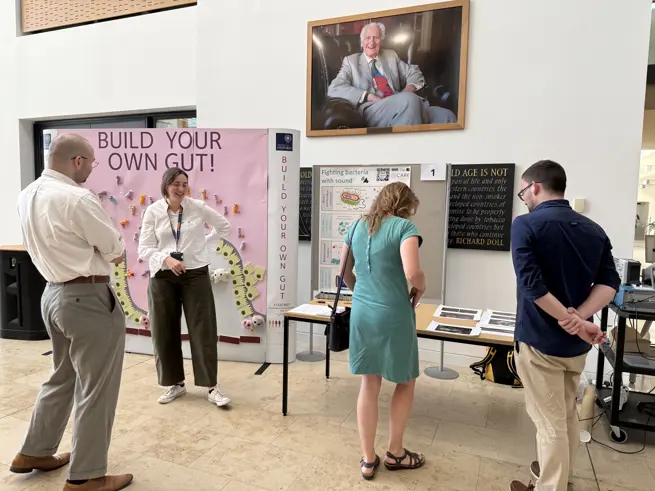
Dr Brans and Dr McLeod showcased their approach using ultrasound and microbubbles to tackle antibiotic-resistant bacteria. Their drug delivery system improves how drugs are transported to harmful bacteria that cause infections in the body. The majority of clinical infections presents with biofilm formation, a community of bacteria and/or fungi in a protective, self-produced slimy matrix, which prevent antibiotics, antiseptics and the body’s own immune cells from reaching the bacteria and curing the infection. Dr Brans and colleagues use microbubbles and ultrasound to physically disrupt these biofilms structures communities. The disruption exposes the previously protected bacteria and makes them vulnerable to existing antibiotics again, offering an alternative to simply developing stronger or new drugs. This work highlights how biomedical engineering and targeted drug delivery methods can play a key role in addressing one of the world’s most urgent healthcare challenges.


